-
Shop
- Adidas
- Advanced Technologies
- Armani
- Bags
- Best-Sellers
- Birkenstock
- Boss
- Calvin Klein
- Car Accessories
- Crocs
- Dating & Social Skills
- Digital Resources
- Budgeting & Saving
- Emotional Intelligence
- Entrepreneurship & Business Growth
- Financial Independence
- Financial Mindset & Psychology
- Goal Setting
- Leadership
- Mindfulness
- Motivation
- Positive Thinking
- Productivity
- Self Confidence
- Sleep Improvement
- Stress Management & Relaxation
- Yoga & Mind-Body Practices
- Dr. Martens
- Drones
- Education & Learning
- Family & Parenting
- Fashion
- Fashion Accessories
- Financial Education
- Furniture
- Gadgets
- Health & Beauty
- Health & Wellness
- Home & Garden
- Home Decor
- Home Supplies
- Kids & Babies
- Lighting
- Massagers
- Mindset
- New Balance
- Nike
- Patio, Lawn & Garden
- Personal Growth
- Pet Care
- Pet Supplies
- Pets
- Shoes
- Sport & Outdoors
- Summer 2025 Fashion Collection
- Sunglasses
- Super Deals
- Timberland
- Tommy Hilfiger
- Travel
- Vans
- Wealth
- Winter Fashion
- Women’s Wellness & Lifestyle
- YouTube Shorts Best-Sellers
Teach Kids Shoe-Tying with a 2PC Wooden Lacing Shoe Toy
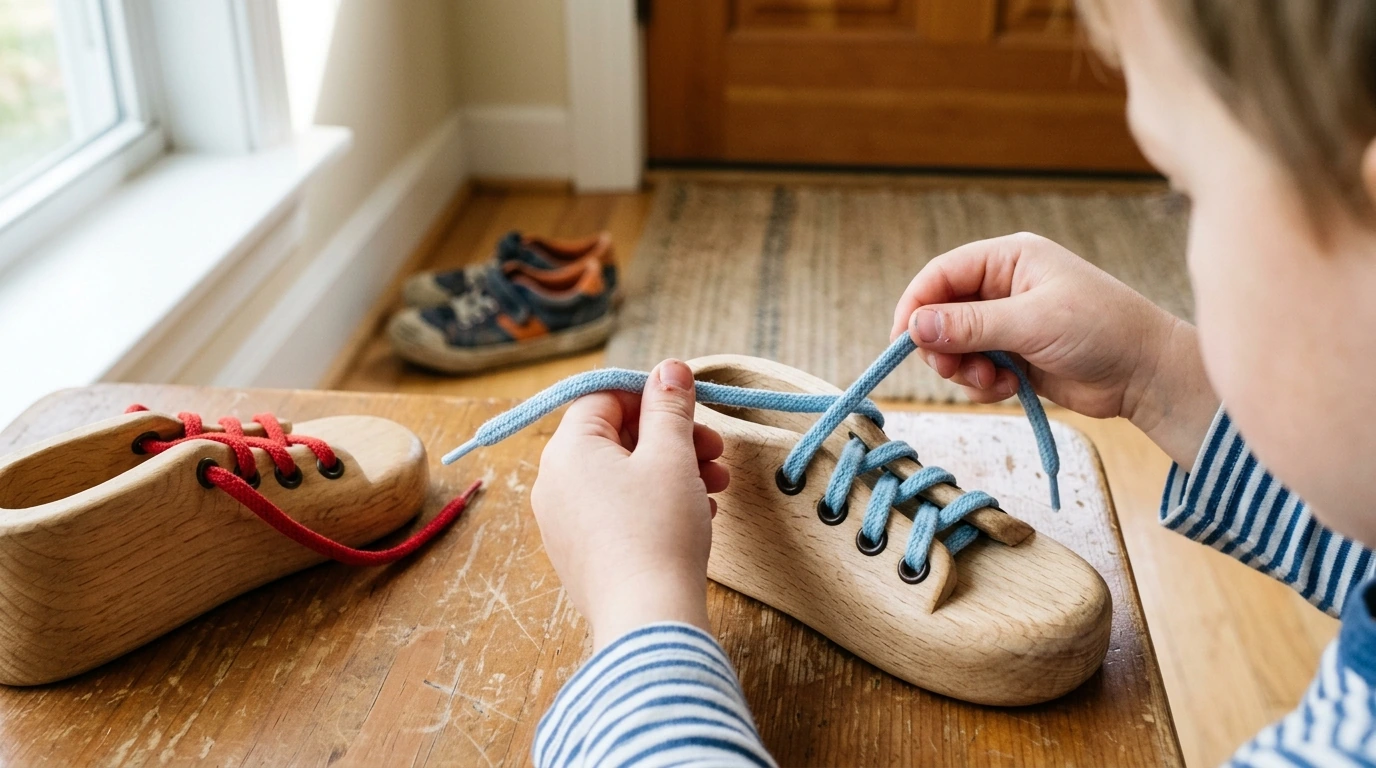
2PC Wooden Lacing Shoe Toy: A Hands-On Way to Practice Real Shoe-Tying Skills
Shoe-tying is one of those everyday skills that grows from repetition—small hands learning to thread, pull, cross, and tighten in the right sequence. Our 2PC Wooden Lacing Shoe Toy turns that learning into play, giving kids a simple, screen-free setup they can pick up again and again to build finger strength, coordination, and confidence before moving to their own shoes. For more guidance, see [PDF] cpsc guidelines for determining age appropriateness of toys.
Why a lacing shoe belongs in the play rotation
When shoe-tying feels “big,” it helps to break it down into mini-movements kids can repeat without pressure. A lacing shoe does exactly that—same action, quick reset, and lots of natural practice. For further reading, see MELISSA & DOUG Melissa & Doug Wooden Lacing Shoe.
- Builds fine-motor control through repeated threading, pulling, and tightening motions.
- Supports hand–eye coordination as kids align the lace tip with each hole and track the path.
- Encourages patience and sequencing (a natural “first, next, then” practice) without feeling like homework.
- Creates a low-pressure place to practice: mistakes are easy to undo and try again.
- Works well for independent play, but also pairs nicely with you modeling the steps side-by-side.
Play-based repetition matters. If you like diving deeper into why hands-on play supports learning, the American Academy of Pediatrics explains the developmental value in The Power of Play.
What’s included and how families tend to use the 2-piece set
Because this is a two-piece set, you can keep practice simple and flexible—without needing to “set up” a whole activity each time.
- Two wooden lacing shoes make it easy to keep one at home and one in a travel bag, or to practice with a sibling or friend.
- Use one shoe for “free lacing” (any pattern) and the other for “challenge lacing” (copy a pattern a grown-up starts).
- Rotate activities to keep interest high: straight-across lacing, crisscross, skipping holes, or making shapes with the lace.
- For early learners, start with slow, big movements: pull the lace all the way through, then pause and reset.
- For kids ready for the next step, practice the same tying routine each time so the sequence becomes automatic.
Our team’s favorite use case: keep one shoe in the “quiet time” bin and the other near the entryway, so practice can happen naturally right before you head out the door.
Skill progression: from threading to tying
Most kids do better when the goal stays small. Instead of “learn to tie,” aim for “learn to thread two holes,” then “learn to even the ends,” then “learn to tighten.” That gradual build-up supports confidence and reduces shutdown moments.
- Start with simple threading: lace in and out of a few holes, then finish the path later.
- Add “even ends” practice: pull both lace ends until they match in length before continuing.
- Introduce crossing and tightening: cross the laces and pull outward to feel how tension works.
- Move to a consistent tying routine: keep language the same each time (loop, wrap, pull through) to reinforce the pattern.
- Keep sessions short and repeatable: a few minutes daily often beats one long session.
Practice stages and what they develop
| Stage | What kids do | Skills reinforced |
|---|---|---|
| Threading | Feed lace tip through holes and pull through | Pincer grasp, bilateral coordination, focus |
| Patterning | Follow a simple lacing route (straight, crisscross) | Sequencing, visual tracking |
| Tension control | Pull both ends to tighten evenly | Grip strength, pressure control |
| Tying routine | Cross, loop, wrap, pull-through | Multi-step planning, independence |
If you ever wonder what “typical” skill-building can look like across early childhood, the CDC’s Developmental Milestones is a helpful reference point (while remembering every child’s timeline is unique).
Ways to make practice feel like play
When practice feels like a game, you’ll usually get more repetitions—and repetition is the whole point. Here are a few low-effort prompts you can rotate through:
- Time-free challenges: “Can the lace visit every hole?” instead of racing a clock.
- Story prompts: “The lace is a trail—make it to the top without skipping a stop.”
- Color cues: call out “left lace, right lace” to reduce confusion when switching hands.
- Turn-taking: one person threads a hole, the other person threads the next.
- Real-life tie-ins: practice right before putting on shoes so the skill connects to the daily routine.
Care tips and safe, frustration-free setup
A simple gifting guide
More in-stock picks from our shop
- 2PC Wooden Lacing Shoe Toy (skill-building, screen-free practice)
- Calvin Klein Retro Square Sunglasses with Dark Lenses (a practical add-on if you’re putting together a “ready to go” gift for the grown-up, too)
FAQ
What age is a wooden lacing shoe toy best for?
Many kids do well with lacing practice in the preschool-to-early elementary range, but readiness depends more on fine-motor control than a specific age. You can start with simple threading and work up to tying steps over time, with close supervision for younger children.
How long does it usually take for a child to learn to tie shoes with practice?
Timelines vary widely, but short, consistent sessions (just a few minutes at a time) tend to work better than occasional long practices. Celebrate smaller milestones—threading smoothly, evening the ends, making a tight cross, and forming a loop—because those add up to independent tying.
How can practice stay fun if a child gets frustrated?
Lower the difficulty fast: do fewer holes, use a simpler pattern, or switch to turn-taking so your child gets quick wins. Keep sessions brief, model slowly using the same words each time, and try to end on a successful step before taking a break.
Recommended for you
Was this article helpful?
Yes
No








Leave a comment